
· Lucie Dewaleyne · Blog · 8 min read
AI and Climate Change: Neither Apocalypse Nor Absolution
Real numbers, False narratives: This debate deserves detter
For the past two years, the debate around the environmental impact of artificial intelligence has swung between two equally unsatisfying extremes. On one side, alarmist headlines claim that AI will « drain the planet dry ». On the other, Big Tech press releases promise carbon neutrality by 2030, backed by carefully curated metrics. The reality is more complex, more nuanced, and ultimately more useful to understand than either of these narratives.
This article lays out the numbers, puts them in context, and answers a simple question: what do we actually know, as of May 2026, about AI’s impact on the climate?
Data Centers consume enormous amounts of energy, and AI is the main driver
First things first: what is a data center?
A data center is simply a large building packed with very powerful computers. These machines run everything we use online continuously: apps, websites, AI models. The problem is that they generate enormous amounts of heat. To prevent them from overheating, they need constant cooling, which consumes both electricity and large quantities of water.
To make it concrete: when you type a question into ChatGPT, your message travels to a data center that mobilises thousands of processors for a few seconds to generate a response. That single operation consumes about ten times more energy than a basic Google search. Multiply that by the billions of daily requests happening worldwide, and the energy bill quickly becomes staggering.
What do the numbers say?
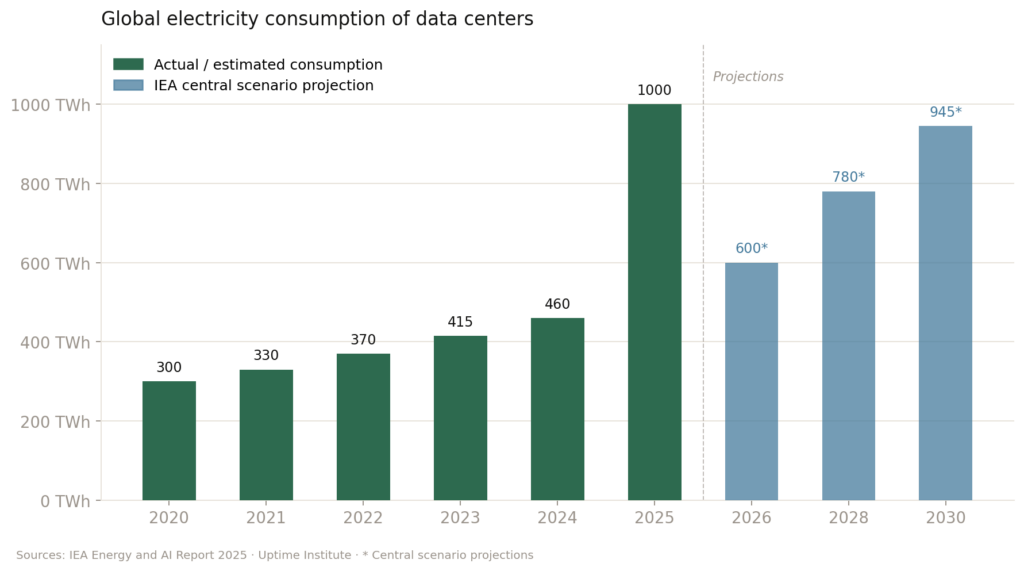
The International Energy Agency estimates that data centers consumed around 415 TWh of electricity in 2024, representing 1.5% of global electricity consumption. To put that in perspective, it is roughly equivalent to France’s entire annual electricity consumption. And this figure is expected to nearly double by 2030, driven primarily by the growth of AI.
To illustrate the scale another way: training a large AI model like GPT-5 requires as much energy as 60 French households consume in an entire year. And a modest-sized data center pumps as much water annually as 300,000 people use. These are not figures invented to cause alarm; they reflect the physical reality of keeping these facilities cool.
Data Centers amplify local pressures without directly causing heatwaves
What is the actual link with extreme heat?
This is where the debate often becomes muddled. Data centers do not « cause » heatwaves in any direct sense. Their relationship with extreme heat is more subtle and plays out at two distinct levels.
At the local level, a data center releases heat into the surrounding air, much like an air conditioning unit that cools the inside of a building by heating the outside. When multiple data centers are concentrated in the same area (as in the Île-de-France region or around Frankfurt), these effects accumulate and worsen what is known as the « urban heat island effect »: the localised overheating of areas that are densely packed with digital infrastructure.
The other problem, even more immediate during heatwaves, is competition for water. During a drought, data centers continue pumping millions of litres to cool their servers, at the exact moment when farmers, power plants and residents also need that same water. Several local authorities in France and across Europe are already beginning to question whether new data center projects are compatible with sustainable water management on their territory.
At the global level, however, the relationship is indirect. It is the consumption of carbon-intensive electricity that contributes to CO₂ emissions, which in turn fuel long-term climate change. A data center powered entirely by renewable energy has a fundamentally different emissions profile from one connected to a coal-heavy electricity grid.
Major pledges conceal an uncomfortable accounting reality
In 2024, Google reported that its total greenhouse gas emissions had increased by 13% in a single year, primarily due to rising energy consumption at its data centers. That figure deserves attention: it comes from a company that regularly presents itself as a global leader in digital sustainability and has been promising carbon neutrality for years.
This is not a criticism of Google specifically. It is an observation that illustrates a structural tension: major tech companies are expected to spend around 650 billion dollars on AI data centers in 2026 alone. At that scale of investment, even the best environmental intentions collide with a simple physical reality: more computation means more energy, and building new renewable energy sources takes time.
Why do figures vary so much depending on the source?
You may have seen studies claiming that data centers account for 14% of the digital carbon footprint in France, and others putting the figure at 46%. A gap of 1 to 3 for the same subject understandably creates confusion.
The explanation is straightforward: it all depends on what you choose to count. Some studies look only at server electricity consumption. Others add cooling systems, building construction, chip manufacturing, data transmission, and sometimes end-user activity. No method is inherently wrong, but they do not measure the same reality. Reading a figure without knowing its scope is like comparing two electricity bills where one includes heating and the other does not.
Efficiency is improving, and regulation is starting to bite
How is a data center’s efficiency measured?
The main indicator used by the sector is called PUE, or Power Usage Effectiveness. It simply measures the ratio between the total energy consumed by a data center and the energy that actually powers the servers. A PUE of 2.0 means that to run 1 watt of server capacity, 2 watts are consumed in total: half is therefore lost to waste (cooling, lighting, backup power). A PUE of 1.0 would be the theoretical ideal, where nothing is wasted.
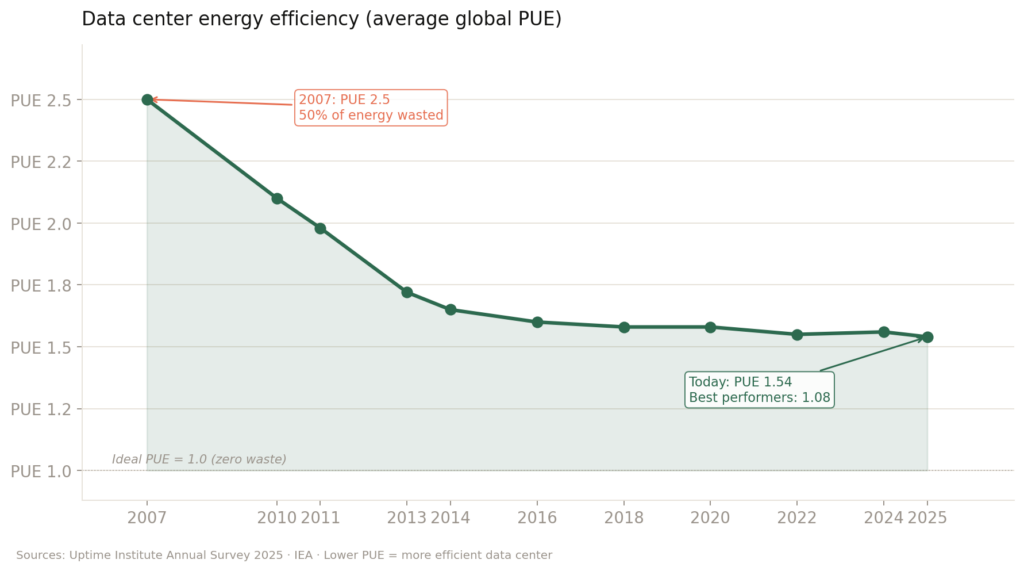
In 2007, the global industry average was 2.5. Today it sits around 1.54. That is a real, documented improvement. The best performers do considerably better: Google, Meta and AWS report PUE figures between 1.08 and 1.15, meaning only 8 to 15% of their energy is lost to waste.
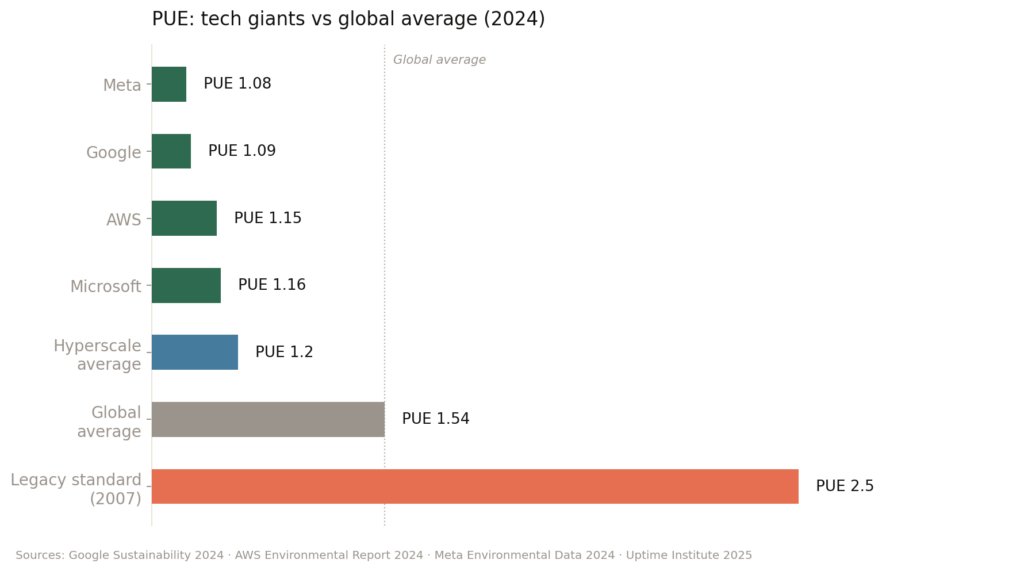
The problem is that these efficiency gains have largely been absorbed by the explosion in computing volume. Far less is wasted per operation, but so many more operations are being run that total consumption continues to climb.
What the law is now requiring
In France, since October 2025, data centers above one megawatt have been legally required to capture and reuse the heat they produce. This heat, estimated at 3.6 TWh by ADEME, can for example feed urban district heating networks or preheat domestic hot water in nearby buildings. Since May 2025, data centers above 500 kW have also been required to publish their energy performance indicators annually. Both obligations send a clear signal: voluntary self-regulation by the sector is no longer sufficient.
AI worsens the climate problem and simultaneously offers tools to address it
A paradox sits at the heart of this debate, and few articles take the time to articulate it clearly. The same computing capacity that powers chatbots and image generators also optimises electricity grids in real time, models climate systems with unprecedented precision, accelerates the discovery of new battery materials, and enables precision agriculture that uses less water and fewer pesticides.
This does not serve as an excuse to ignore the environmental impact of the sector. It does, however, invalidate overly simple readings in either direction. Articles headlining « AI is stealing our water » in 2026 sometimes describe data centers built in 2020. The sector evolves quickly, regulatory obligations are beginning to produce measurable effects, and today’s numbers do not mechanically predict tomorrow’s.
A provisional assessment of a question that will remain open
The data available in May 2026 allow several things to be stated with reasonable confidence. The energy and water consumption of AI data centers is, indeed, real, documented and growing strongly. Its link to heatwaves remains indirect at a planetary scale, yet it becomes locally significant, particularly regarding water resources during drought episodes, since data centers continue drawing water at the precise moment when that resource is already under pressure. Technical efficiency gains are real, therefore encouraging, yet insufficient in the face of exploding demand. Finally, regulation is gradually tightening, at least in Europe, which signals that voluntary self-regulation by the sector is no longer adequate.
The question that remains open is therefore not a technical one. Societies, regulators and companies will need to decide how quickly they are prepared to evolve their practices, regulations and business models, because AI’s growth cannot continue indefinitely without accounting for its true climate cost.