
· · Lucie Dewaleyne · Blog · 6 min read
AI shopping agents: your next customer may not be human
Since October 1, ChatGPT can show you a jacket on your own selfie. On Monday, October 5, TikTok announced an assistant that answers your questions about a product, then lets you buy it in one click. In between, CNBC walked through how Muse, Meta’s agent, fills a basket and prepares the payment for you.
Taken one by one, these look like gadgets. Put side by side, they show that the AI shopping agent, software that searches, compares and orders for you, is landing in apps that everyone already uses. I design buying journeys all year long, so I wanted to work out what this changes for you, and for brands that sell online.
Three announcements in five days tell the same story
Let’s start with ChatGPT. Some clothes and accessories now come with a « Try on » button: you upload a selfie and the tool generates a picture of you wearing the item. The feature is rolling out worldwide, on the web and on mobile. It shows you a look, but it does not guarantee the size or the fit.
Meta goes further with Muse, which launched in the United States in early September. You describe what you want, with the brand, budget and availability if you like. The agent then browses retail sites, suggests a shortlist and prepares the order. Meta has signed partnerships with Walmart, Sephora, Gap and Best Buy, among others. The app passed 5 million downloads in 22 days and, according to a company spokesperson, shopping is one of its biggest uses.
TikTok, finally, introduced its Shopping Assistant: a conversational agent that gives product details, sizing, shipping and availability, paired with one-click checkout from the For You feed. The company is building this with Shopify, Stripe and Salesforce.
All three want the same thing: to keep the shopper inside their app from the first question to the payment.
An AI shopping agent fills the basket, but you approve the payment
A chatbot answers a question. An agent acts. It is a bit like handing your shopping list to someone you trust, who comes back with the receipt and waits for your signature.
At Meta, that signature is an « approval card ». It sums up the order, and nothing goes through without your confirmation. Payment runs through wallets such as Link, by Stripe, which according to Meta generates a one-time-use card so your real card details stay hidden.
As a designer, this approval screen is the part I find most interesting. The rest of the journey becomes invisible, so trust comes down to that single moment: do I understand what I am buying, at what price, and from whom?
Shoppers are still reluctant to hand over their card
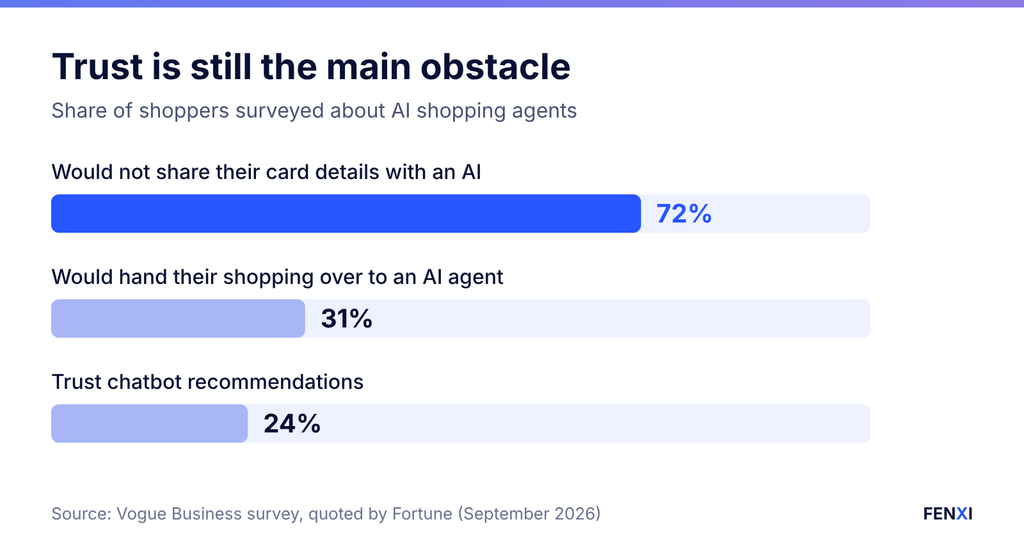
The numbers call for some caution. In a Vogue Business survey quoted by Fortune, only 31% of respondents said they would hand their shopping over to an AI agent, even one that knew their taste. Just 24% trust chatbot recommendations, and 72% would not share their card details.
Yet usage is growing fast. During the 2025 holiday season, traffic from AI assistants to US retail sites jumped 693.4%, according to Adobe data reported by Reuters. Mastercard, for its part, predicts that one in ten shoppers will use a personal AI agent by 2030.
These figures do not contradict each other. We are happy to let AI search and compare for us, but far fewer of us will let it pay.
Europe still has a little time
Muse is only available in the United States, and TikTok’s announcements target the American market first. In Europe, what you can see today is mostly search and recommendation, plus ChatGPT’s virtual try-on.
That is already a lot. When someone asks an assistant « which waterproof jacket under 150 euros? », the answer names a handful of brands. The others simply do not exist in that conversation.
An agent reads your product data, not your homepage
A human visitor looks at your photos, your tone, your layout. An agent looks for facts: price, stock, sizes, delivery times, return conditions. If that information sits inside an image, changes from one page to the next or hides behind a « contact us », I think it will go and look elsewhere.
Analysts quoted by the Wall Street Journal made the same point about Shopify: its strength in this new chain comes from organising product data in a catalogue that agents can read.
This work has a name, GEO, for Generative Engine Optimization. It works much like SEO: where SEO makes a site readable by Google, GEO makes it readable and quotable by AI assistants. It does not replace user experience, because a human still approves the purchase and often ends up visiting the site.
Your site can get ready now
Here is where I would start:
- Ask ChatGPT, Gemini or Perplexity the questions your customers ask. See whether your brand comes up, and whether what is said is accurate.
- Reread your product pages. Price, availability, sizes, delivery and returns should be written in plain text and backed by structured data, the markup that machines read without having to guess.
- Check that this information is identical on your site, on marketplaces and on your social accounts.
I do not believe we will all hand our shopping to an AI next year, and the 72% who keep their card to themselves rather back me up. Search, however, has already shifted: some of your future customers discover brands in a conversation with an AI before they see a single website.
If you want to know where you stand, Fenxi is offering a free GEO audit. We look at how AI assistants talk about your brand today, and what stops them from recommending you. Get in touch to claim yours.
Sources
- TechCrunch, « TikTok rolls out an AI shopping assistant and one-click checkout », October 5, 2026
- CNBC, « Meta’s Muse can shop and check out for you. Here’s how it works », October 3, 2026
- Tech Startups, « Meta’s Muse can shop and check out for you », October 5, 2026
- JustGeek, « ChatGPT peut vous faire essayer virtuellement des vêtements », October 2, 2026 (in French)
- KultureGeek, « ChatGPT propose maintenant d’essayer virtuellement des vêtements », October 2026 (in French)
- LeBigData, « L’essayage virtuel de ChatGPT vous le fait porter sans l’enfiler », October 2026 (in French)
- Fortune, « Meta built an AI that can shop for you », September 11, 2026 (Vogue Business survey, Adobe data via Reuters, Mastercard forecast)
- Quartz, « Shopify is letting Meta’s new AI agent shop and check out on users’ behalf », September 22, 2