
· · Lucie Dewaleyne · Blog · 5 min read
GPT-5.5 vs Gemini 3.5 vs Fable 5: Which AI Model Should You Pick in 2026?
Update July 2026: since this comparison was published, Claude Opus 5, GPT-5.6 Sol and Kimi K3 have arrived. For the latest matchup, read our Claude Opus 5 vs GPT-5.6 Sol vs Fable 5 vs Kimi K3 comparison.
GPT-5.5 vs Gemini 3.5 vs Fable 5: The 2026 Comparison
TL;DR: there is no longer a single best AI model in 2026. Claude Fable 5 dominates coding and autonomous agents (80.3% on SWE-Bench Pro), Gemini 3.5 Pro wins on document volume (2 million tokens), and GPT-5.5 leads on long-context reliability. The right choice depends on the job, not a single ranking.
| Criterion | GPT-5.5 | Gemini 3.5 Pro | Claude Fable 5 |
| Context window | 256,000 tokens | 2,000,000 tokens | 1,000,000 tokens |
| SWE-Bench Pro (coding) | 58.6% | 54.2% | 80.3% |
| Agentic score | — | — | 80.7 (highest on the market) |
| Reasoning (average) | 85 | 77 | — |
| Long-context fidelity (8-needle MRCR) | 74% | 26% | — |
In just a few weeks during spring 2026, the three major AI labs reshuffled the deck. OpenAI shipped GPT-5.5, Google DeepMind confirmed Gemini 3.5 Pro with its record 2-million-token context, and on June 9 Anthropic unveiled Claude Fable 5, the first model in a new tier called Mythos. For any company looking to adopt AI, the question is no longer whether to do it, but which model to choose, and for what. Because these three are far from interchangeable: each one dominates a different field.
Three philosophies, three positions
GPT-5.5 remains the versatile all-rounder. Released in April 2026, it keeps a 256,000-token context window and stands out for its reasoning discipline, averaging 85 on logic tasks. Pricing sits around 5 dollars input and 30 dollars output per million tokens.
Gemini 3.5 Pro bets on contextual scale. With 2 million tokens, the largest window of any production frontier model announced so far, it swallows entire document bases without flinching. Its Deep Think mode pushes reasoning further, and its strength on multimodal tasks (text, image, audio, video) makes it the natural pick for media-rich use cases.
Claude Fable 5 aims for raw peak performance. Positioned above the Opus line, it combines a 1-million-token window with vision and tool orchestration. Anthropic calls it its most capable public model ever, state of the art on nearly every benchmark tested.
Coding and agentic work, where Fable 5 dominates
The gap widens most clearly on software engineering. On SWE-Bench Pro, which measures the ability to solve real code tickets, Fable 5 hits 80.3 percent, well ahead of GPT-5.5 at 58.6 percent and Gemini 3.1 Pro at 54.2 percent. On the hardest split, called Diamond, it reaches 29.3 percent, more than double Anthropic’s previous model.
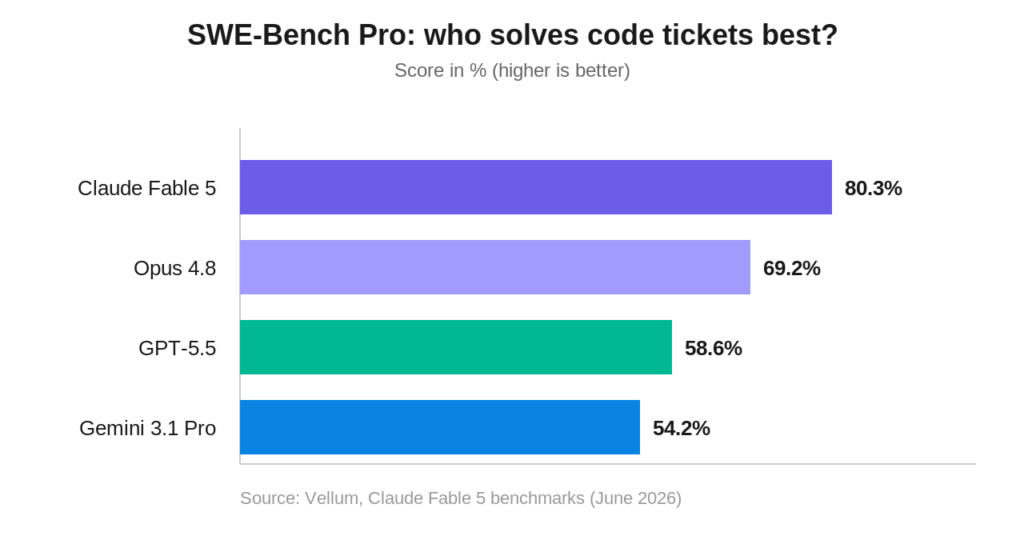
SWE-Bench Pro scores of 2026 AI models Claude Fable 5 reaches 80.3%, Opus 4.8 69.2%, GPT-5.5 58.6% and Gemini 3.1 Pro 54.2% on the SWE-Bench Pro software engineering benchmark. SWE-Bench Pro: who solves code tickets best? Score in % (higher is better) Claude Fable 5 80.3% Opus 4.8 69.2% GPT-5.5 58.6% Gemini 3.1 Pro 54.2% Source: Vellum, Claude Fable 5 benchmarks (June 2026).
Its agentic score of 80.7 is also the highest on the market, making it the strongest candidate for autonomous agents that chain multiple steps without supervision. For teams building coding assistants or multi-tool workflows, the edge is tangible.
Where GPT-5.5 keeps the upper hand
Fable 5’s dominance is not absolute. On pure reasoning, GPT-5.5 keeps a slight lead, averaging 85 versus 77 for its direct rivals. More importantly, it stays unbeatable on long-context fidelity: on the 8-needle MRCR test, it retrieves 74 percent of information at a full million-token load, where Gemini collapses to 26 percent. In other words, a large window is useless if the model loses the thread. For analyzing bulky contracts or long histories, that reliability makes the difference.
Price, the blind spot of the decision
Performance is not the whole story, because the bill climbs fast at scale. GPT-5.5 sits among the most expensive, at 5 and 30 dollars per million tokens. Gemini 3.5 Pro lands around 15 and 60 dollars, justified by its outsized context. Fable 5, in the premium Mythos class, targets high-value use cases where quality beats cost. That is why many companies now go hybrid: a fast, cheap model for volume, a high-end model for critical tasks.
How to choose in practice
For software development, autonomous agents or high-stakes document analysis, Fable 5 stands out. To process huge document volumes or multimodal content, Gemini 3.5 Pro and its 2 million tokens take the lead. For reliable reasoning over long contexts with a mature ecosystem, GPT-5.5 remains a safe bet.
The real answer, in 2026, fits in one sentence: there is no longer a single best model, only the best model for a given job. Building an AI architecture now means knowing how to route each task to the model that serves it best. That is exactly where performance, and cost control, are won. For the newest matchup, read our Claude Opus 5 vs GPT-5.6 Sol vs Fable 5 vs Kimi K3 comparison.